Your highest-risk patients, supported at home
Juvo Care is an AI-native, HIPAA-aligned platform that connects your care teams with screened, independent in-home caregivers. Refer a patient, and Juvo Care reaches them within one business day. Your team sees what happens next: whether care started, how the patient is doing, and when a risk appears.

Reduce readmissions and avoidable emergency visits
The weeks after a discharge, or after a high-risk diagnosis, are when patients slip: missed medications, a fall, a diet that drifts, nobody in the home to notice. An in-home caregiver covers that window. Help with daily living, medication reminders, meals, and rides to follow-up visits, and someone in the home who notices changes early and passes them on.
A caregiver who is in the home each week notices changes early: a missed meal, a fall risk, a new confusion. Those observations reach the family and the care team in time to act, which is how avoidable emergency visits get avoided.
For inpatient teams, a confirmed caregiver at home can be the difference between discharging today and discharging Thursday.
After the referral, you'll know what happened
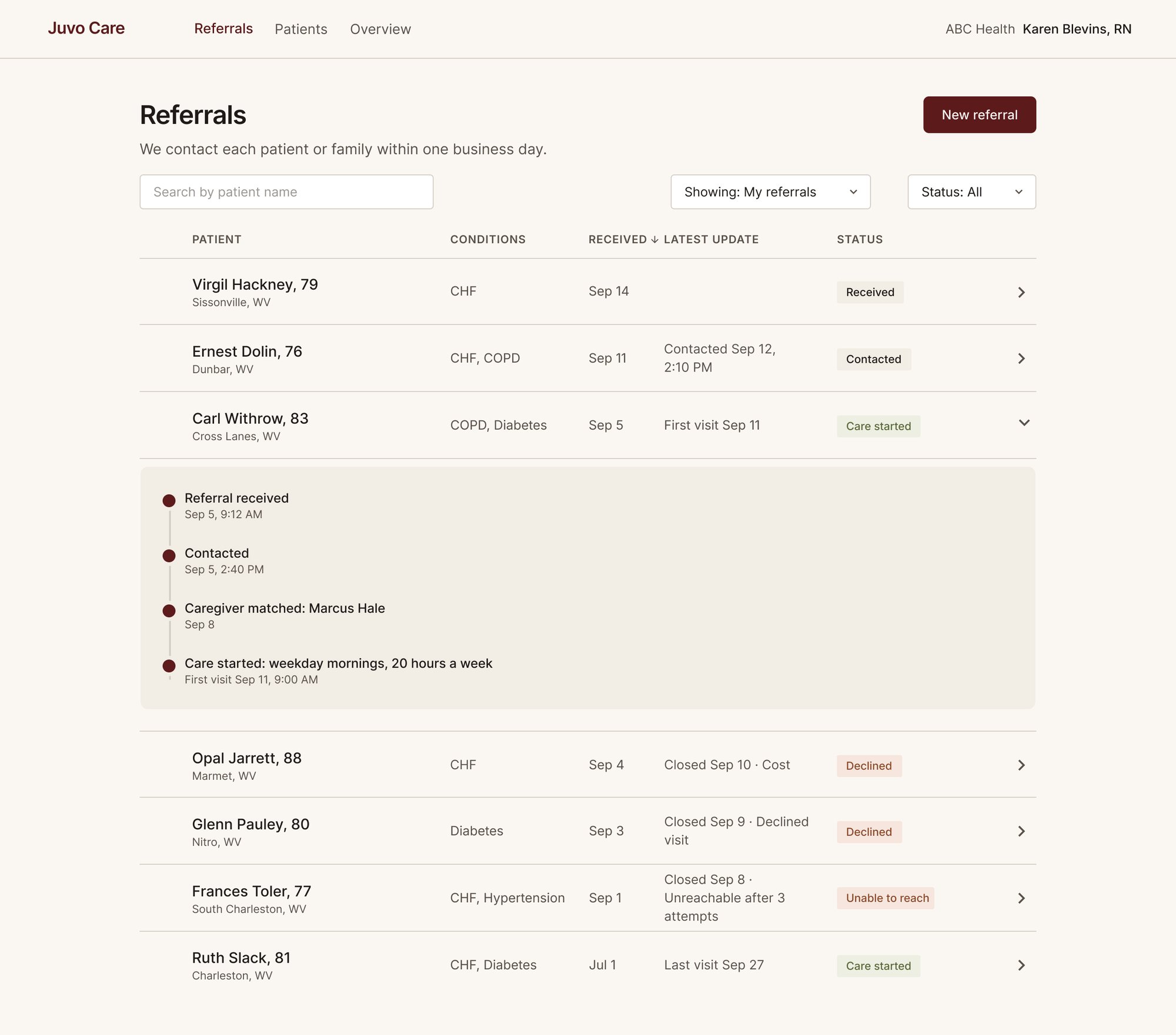
Today, a referral to a private-duty provider disappears. You find out how it went when the patient is back in your ED. Juvo Care closes that loop. Your team sees each referred patient's status: contacted, care started, or not taken under care and why; how the patient is doing; medication reminders kept; time since the last visit; and an alert when the caregiver flags a change. The referring provider hears back, every time.
Quality scores and patient experience
Patients recover at home, on their own terms, with someone they chose. Fewer readmissions and ED visits, and a smoother handoff, support the quality and patient experience measures your contracts already carry.
Patients who benefit most
In-home support makes the biggest difference for patients whose recovery depends on what happens between visits.
- Heart failure. Daily weights, low-salt meals, medications on time, and someone who notices the swelling before it becomes an admission.
- Diabetes. Regular meals, medication reminders, rides to follow-ups, and eyes on the small changes that lead to an ED visit.
- COPD. Help with daily tasks that leave patients breathless, and a companion who notices when breathing changes.
- Recovering from sepsis or a hospital stay. The weeks after discharge, when patients are weakest and most likely to return.
- Behavioral health and isolation. Many avoidable ED visits start with a patient who is alone. Regular visits, meals, and companionship are the intervention.
- Older adults living alone. Anyone whose care plan assumes someone is in the home when nobody is.
How a referral works
- Refer Send a referral the way your team already works: by phone, by secure fax, or through the Juvo Care partner portal, where you can also see every referral's status in one place.
- We reach out within one business day Juvo Care contacts the patient or their designated contact, explains the service, and confirms interest and cost.
- The family meets a caregiver We match a screened caregiver near the patient. The family meets them first and decides. Care starts when they say so.
- You see what happens Status comes back to your team at each step, and after care starts: how the patient is doing, and any change the caregiver flags.
Who provides the care
Talk to our team
We're working with health systems now. Tell us about your population and we'll set up a conversation.